Content Marketing Strategies
The Complete Guide to Answer Search Optimisation
What is Answer Search Optimisation?
Answer Search Optimisation (ASO) is the process of creating content that helps your business appear in AI-generated answers from platforms such as ChatGPT, Claude, Perplexity and Gemini.
Traditionally, search engine optimisation focused on helping your website rank on Google. Answer Search Optimisation goes a step further. The goal is to help AI models understand your expertise, trust your content and reference your brand when answering questions.
When somebody asks ChatGPT for the best digital marketing agency, the best accounting software or how to create a content strategy, the AI does not simply look for websites with the strongest backlinks. It looks for trustworthy sources, topical authority and content that directly answers the user’s question.
Businesses that invest in Answer Search Optimisation today are positioning themselves to be discovered wherever people search tomorrow. Check out the 5-Step Answer Search Optimisation Framework, to learn how to deploy ASO strategies in your business.
The Death of the Ten Blue Links
For over twenty years, the internet worked in a relatively simple way.
- A user typed a query into Google.
- Google returned ten blue links.
- The user clicked one.
- The website won.
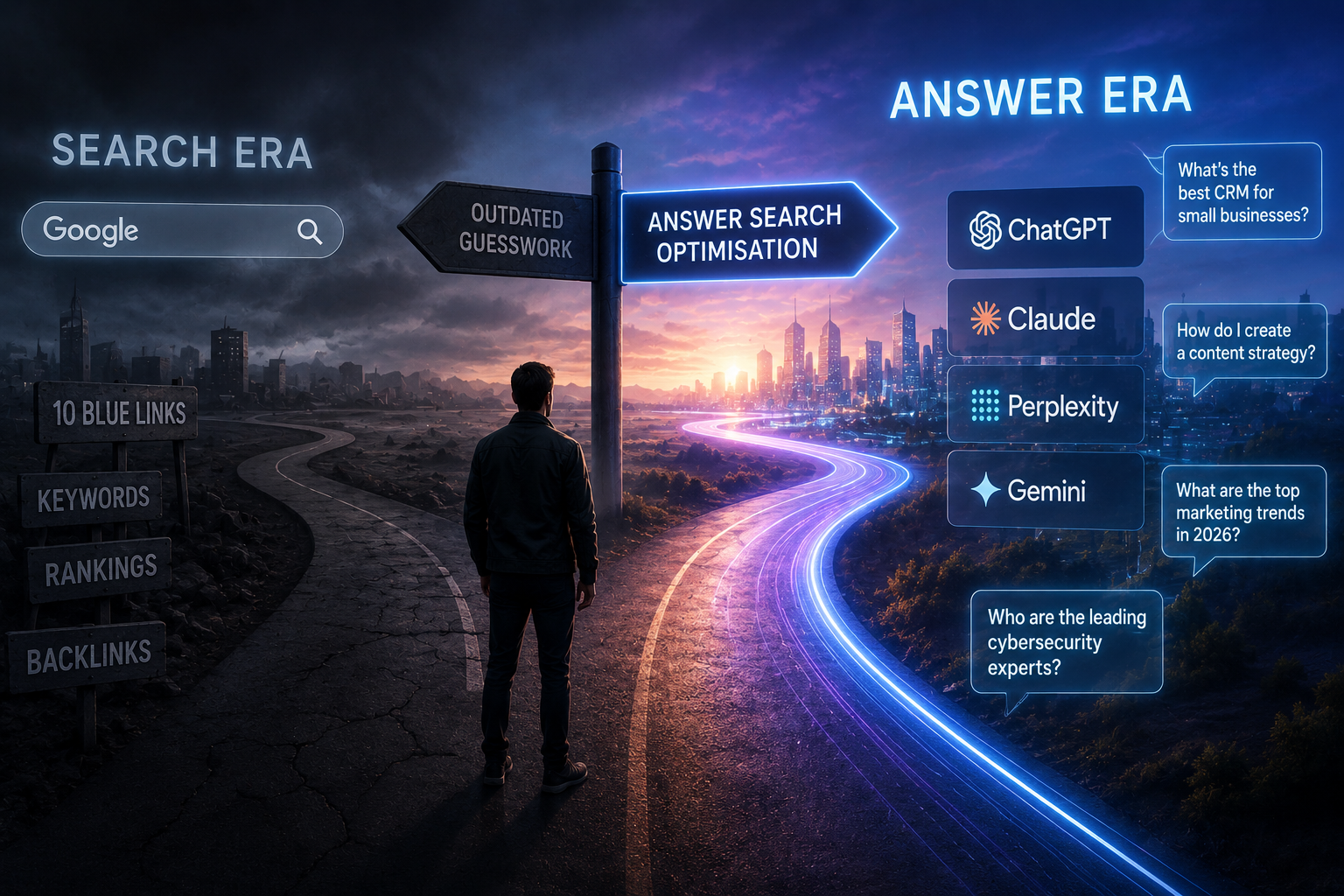
That model is changing rapidly. People are increasingly asking questions directly to AI assistants rather than search engines.
Instead of searching for: “Best CRM software”
They now ask: “What is the best CRM for a small business with less than 20 staff?”
The difference is significant. The search engine era rewarded ranking. The AI era rewards expertise.
Your Customers Are No Longer Searching in One Place
Most businesses still think about Google. Their customers do not.
Today, people search across multiple platforms depending on what they want to achieve. Our 2026 research in Large Language Model usage gives a clear picture:
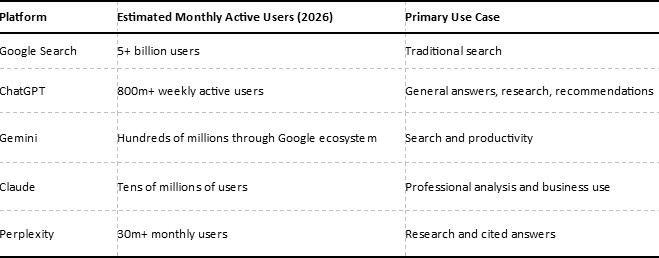
- Google remains the dominant search platform with billions of searches every day.
- ChatGPT has become the fastest-growing answer engine in history and now handles hundreds of millions of weekly users.
- Perplexity has built its reputation around cited answers and research-led responses.
- Claude is increasingly being used by professionals for business advice, analysis and content creation.
Gemini is deeply integrated into Google’s ecosystem and is becoming a natural extension of traditional search behaviour.
The reality is simple. Your customers are no longer asking one search engine. They are asking multiple AI assistants. And those assistants are deciding which brands deserve attention.
The Four Types of Search Intent Still Matter
Whilst the technology has changed, human behaviour has not. People still search with one of four intentions:
1. Informational Intent
The user wants to learn something.
Examples:
What is Answer Search Optimisation?
How does SEO work?
What is a marketing strategy?
This is where educational blogs perform best.
Navigational Intent
The user already knows where they want to go.
Examples:
Blog Beaver login
HubSpot pricing
Facebook login
These searches are often brand driven.
3. Commercial Intent
The user is researching options before making a decision.
Examples:
Best AI writing tools
Blog Beaver vs Jasper
Best content marketing platforms
These searches often produce the highest quality leads.
4. Transactional Intent
The user is ready to act and is showing a high level of purchasing intent.
Examples:
Buy AI content software
Book marketing audit
These searches convert. A strong content strategy supports all four types of intent. Most businesses only create content for transactional intent and then wonder why nobody finds them.
Why Most Businesses Never Become the Recommended Brand
Ask ChatGPT a question and you’ll notice something interesting. The same brands appear repeatedly. That is not an accident.
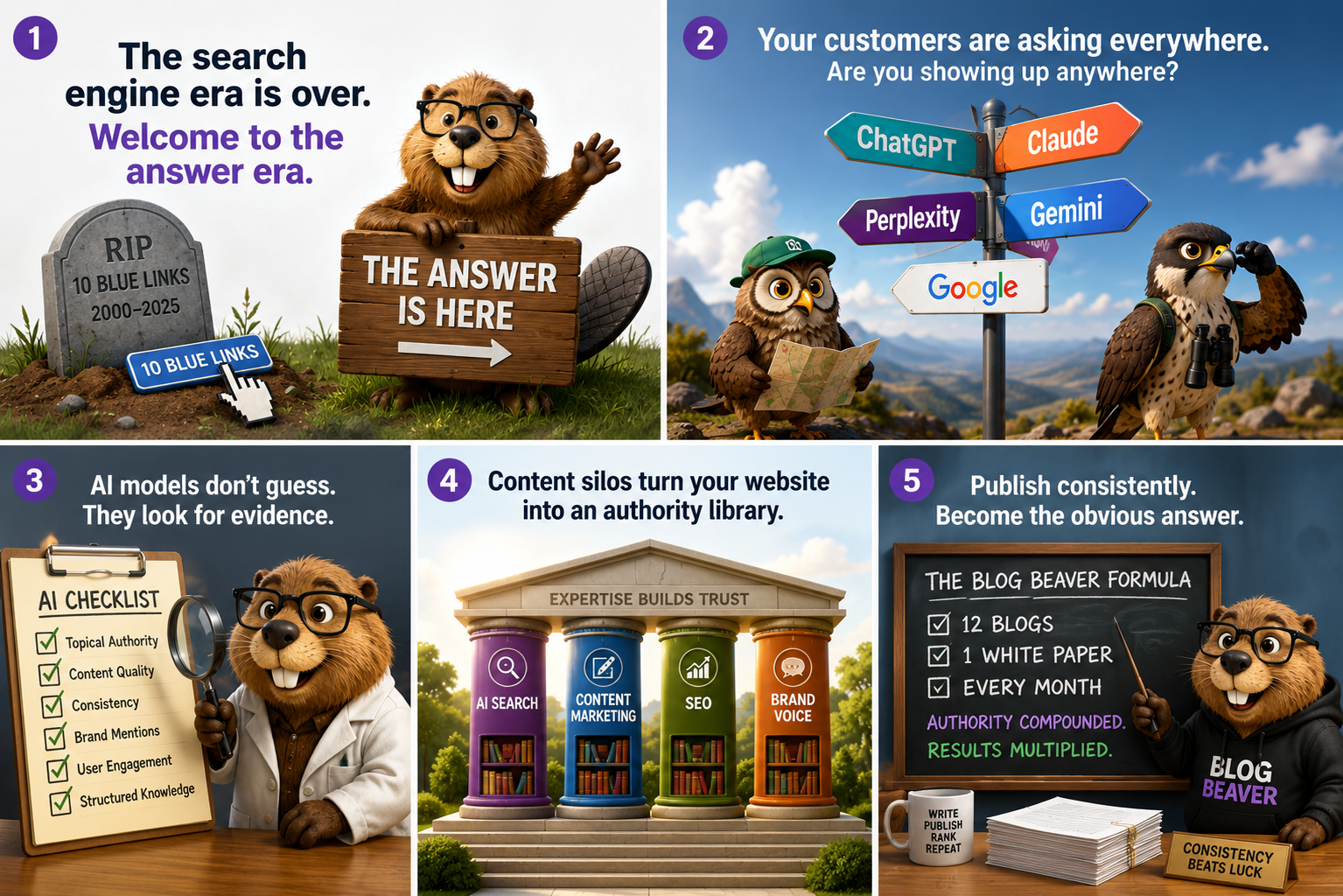
AI systems favour organisations that demonstrate authority around a topic. Think of your website as a library.
Most SME websites contain ten or twenty disconnected pages. AI struggles to understand what they are experts in. Now imagine a website containing hundreds of articles around a given topic. Suddenly the picture becomes clear. The website becomes a recognised authority.
This is why content silos matter, or as I call them “content mountains” matter.
Content Silos Are Your Competitive Advantage
A content silo is a collection of related content built around a single topic.
Taking our site as an example, the silos might include:
AI Search – Everything about ChatGPT, Gemini, Claude and Perplexity.
Content Marketing – Blogs, white papers, thought leadership and learning centres.
SEO – Technical SEO, local SEO and Answer Search Optimisation.
Brand Voice- Human-led content, storytelling and content quality.
Every article strengthens the others. Every page adds context. Every piece reinforces authority. Over time, AI systems begin associating your brand with expertise in that category. That’s exactly what you want.
Why Publishing Frequency Matters More Than Ever
One blog per quarter is not a content strategy. One blog a week is also no longer a comprehensive strategy. It is wishful thinking.
AI models reward evidence of expertise. Expertise is demonstrated through volume, consistency and quality.
Publishing regularly creates more opportunities to:
- Rank in search
- Be cited by AI
- Earn backlinks
- Build authority
- Generate leads
This is one of the reasons we built Blog Beaver the way we did.
Every month the platform creates:
- 12 professionally written blogs
- 1 research-led white paper
That gives businesses a consistent flow of content without needing a full marketing department. The goal is not simply publishing more. The goal is becoming impossible to ignore.
The Businesses That Win Will Teach Better Than Everyone Else
Many companies still use their websites as digital brochures. That approach is becoming obsolete. The businesses winning in AI search are becoming publishers. They answer questions. They educate buyers. They create resources. They build trust before the sales conversation begins.
The companies that teach best are increasingly becoming the companies that sell most.
How AI Models Decide Which Brands To Mention
Many business owners assume AI tools simply scan the internet and choose the most popular company. The reality is far more sophisticated. Large Language Models look for signals that indicate authority, expertise and trustworthiness. Whilst nobody outside OpenAI, Anthropic or Google knows the exact weighting, we can observe several common patterns.
Topical Authority
AI systems favour websites that demonstrate deep knowledge around a specific subject. A website with 100 articles about content marketing is far more likely to be referenced than a website with three generic blogs covering unrelated topics. Depth matters.
Consistency
Brands that publish consistently create a larger body of evidence. Every article becomes another proof point that the business understands its subject matter.
Content Quality
AI systems reward content that genuinely answers questions. The days of writing 500 words stuffed with keywords are disappearing quickly. Clear explanations outperform keyword stuffing every time.
Brand Mentions
AI models look beyond your website. Mentions across news sites, podcasts, industry publications, directories and social platforms all contribute to credibility. This is one reason Digital PR has become increasingly valuable.
User Engagement
Content that people spend time reading sends positive signals. If visitors arrive and immediately leave, that content is unlikely to be perceived as useful.
Structured Knowledge
Learning Centres, topic clusters, FAQs, guides and white papers make it easier for AI systems to understand your expertise. The easier you make it for machines to understand your business, the more likely they are to reference it.
The takeaway is simple. AI does not reward the loudest brand. It rewards the clearest expert. Brands that consistently develop content that is not generic AI-slop, but meaningful insight-based content that offers genuine opinions.
The Future Belongs to Answer Engines
Search is not disappearing. It is evolving.
The next generation of customers will increasingly ask AI assistants for recommendations, advice and solutions. When that happens, one question matters. Will your business be part of the answer? If not, now is the time to change that.
Ready to Build Your Authority?
Blog Beaver helps businesses create 12 professionally written blogs and a research-led white paper every month. No content mills. No generic AI copy. No endless blank pages staring back at you. Just consistent, high-quality content designed to build authority, increase visibility and help your business get found in Google, ChatGPT, Claude, Gemini and Perplexity.
Start your free trial today and discover why smart businesses are investing in Answer Search Optimisation before their competitors do.
About the author – Steve Pailthorpe
Steve Pailthorpe is one of the world’s leading marketing speakers and authors. For the last 15-years he has spoken in the USA and in the UK on topics such as digital marketing, search engine optimisation and how to use large language models effectively. His 7-steps marketing chassis has been used by some of the leading educational institutions around the world and his ‘CREATE prompt formula’ is widely accepted as one of the first AI prompt models for SME businesses. He is the AI ambassador for the IoD and has multiple industry awards for his work. Steve is the marketing strategist behind the Blog Beaver platform and runs several online marketing agencies, having helped hundreds of clients to scale. Find out more about Steve at https://www.stevepailthorpe.com.
Simple pricing, serious output.